
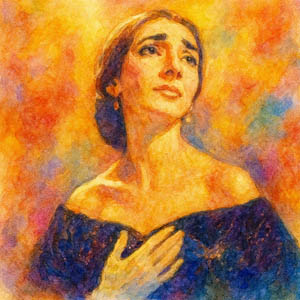
 Some voices carry not just sound, but a lifetime of longing, courage, and wonder.
Passionate and fiercely dedicated, Maria Callas (1923–1977) was born Cecilia Sophia Anna Maria Kalogeropoulos in
New York City. “Child prodigies never enjoy true childhood,” she once reflected. “I can’t remember a toy I cared about... only the songs I sang and sang and sang.”
Some voices carry not just sound, but a lifetime of longing, courage, and wonder.
Passionate and fiercely dedicated, Maria Callas (1923–1977) was born Cecilia Sophia Anna Maria Kalogeropoulos in
New York City. “Child prodigies never enjoy true childhood,” she once reflected. “I can’t remember a toy I cared about... only the songs I sang and sang and sang.”
In 1941, she made her debut as Tosca at the Athens Opera, soon earning the title “La Divina” from devoted admirers. A transformative soprano, Callas brought deep emotional truth to every role and reshaped how audiences understood opera.
“To sing is an expression of your being, a being which is becoming,” she said. Her powerful interpretations of Aida and Turandot revealed her extraordinary range and magical command of the stage.
“If you want to live in harmony with yourself, you have to work,” she explained. “Work very hard. I don’t agree with Descartes: ‘I think therefore I am.’ My motto is ‘I work therefore I am.’”
Her personal life was often as dramatic as her performances. The world watched her complicated relationship with Greek shipping magnate Aristotle Onassis, and she grieved deeply after his marriage to Jacqueline Kennedy.
According to New York Times music critic Harold Schonberg, Callas was an artist “who lived her roles and made them come to life… She looked on opera as theater as well as voice, and she was the one who put it all together.”
Though her life held its share of sorrow, Callas carried a quiet resilience. She poured her heart into every role, finding refuge in music when the world felt unkind. Her voice endures as a reminder that even in difficult seasons, beauty can rise from longing, and imagination can carry us home.
 Let
Let