
— Pythagoras
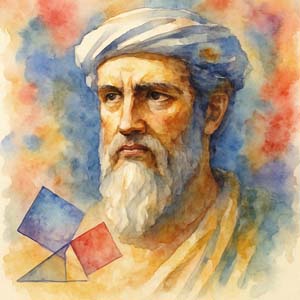 Pythagoras (c. 571–496 BCE), often called the "Father of Mathematics," was born on the island of Samos in ancient Ionia. He was the first to call himself a philosopher—a lover of wisdom.
A mystic and mathematician, he inspired generations from Plato and Aristotle to Isaac Newton. Pythagoras believed that music and numbers were gateways to understanding the harmony of the universe.
He famously declared: “The oldest, shortest words, yes and no, are those that require the most thought.”
His theories helped lay the foundation of geometry. The Pythagorean Theorem (a² + b² = c²) unlocked ways to measure space, build structures, and deepen our understanding of form and order.
Pythagoras founded a school whose members practiced silence, vegetarianism, and spiritual discipline. They even avoided eating beans, believing them to resemble the beginning of human life.
He taught that a life of reflection leads to clarity. “Rest satisfied with doing well,” he said, “and leave others to talk of you as they please.”
Pythagoras reminds us to think deeply, live deliberately, and seek balance between reason, rhythm, and reverence.
✨Pythagoras is honored on the Top 100 Innovators list for revealing the harmony of numbers and planting the seeds of mathematics, music, and philosophy. 🎶📐💫
 Live deliberately.