
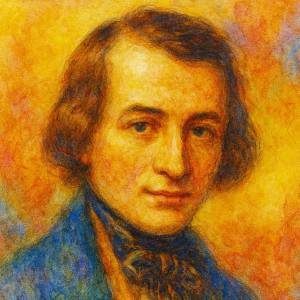
 Born on this day in Düsseldorf, German poet Heinrich Heine (1797–1856) knew the
moment when language reached its edge and melody had to take over. He studied law before publishing his first
poetry in 1822, weaving humor and awareness into lines that
lingered like a song.
Born on this day in Düsseldorf, German poet Heinrich Heine (1797–1856) knew the
moment when language reached its edge and melody had to take over. He studied law before publishing his first
poetry in 1822, weaving humor and awareness into lines that
lingered like a song.
“The fountain of love is the rose and the lily, the sun and the dove,” he once observed, blending romance with a clear-eyed understanding of the soul. His best-known collection, Buch der Lieder (The Book of Songs), was published in 1827. Composers were captivated: Heine’s lyric poems would eventually be set to more than 3,000 pieces of music.
“The heart is like the sea,” said the romantic writer. “Subject to storms, ebb tide, and flood, and in its depth is many a precious pearl.” Troubled by illness and exile, he still trusted that even grief could be transformed into beauty .
To escape German censorship, Heine settled in Paris, where he worked as a journalist and cultural critic during a time of fermenting new ideas. He moved among the most talented minds of his age, including writers such as George Sand and Victor Hugo, watching revolution and art reshape Europe.
“Out of my great woe I make my little song,” Heine believed, an advocate for clear thinking and political action. “Experience is a good school, but the fees are high.” His wit could be sharp, but beneath it lived tenderness for all who suffer and still keep singing.
Today, whenever a melody carries the truth our tongues cannot quite hold, we know his wisdom again: when words fall away, music steps in — and the heart finds another way to speak.
 Let music say what words cannot. 🎵