
~ John Milton
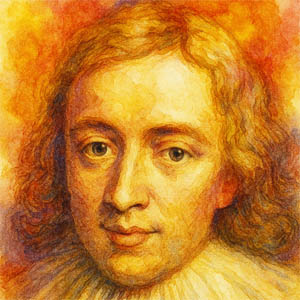 Born on this day in London, English writer John Milton (1608–1674) held bold political
and religious views and ultimately rejected his family’s hope that he would become a minister. Instead, he
turned to writing as his way to reform the Church of England and speak to the conscience
of his time.
Born on this day in London, English writer John Milton (1608–1674) held bold political
and religious views and ultimately rejected his family’s hope that he would become a minister. Instead, he
turned to writing as his way to reform the Church of England and speak to the conscience
of his time.
“A good book is the precious life-blood of a master spirit,” he said, “embalmed and treasured up on purpose to a life beyond life.” For Milton, books carried living voices across generations, keeping wisdom and wonder alive.
He wrote revolutionary pamphlets that defended the morality of divorce in cases of deep incompatibility and traveled to Italy, where he met Galileo. Milton fought fiercely for freedom of the press and rebelled against Parliament’s censorship, believing that truth was strong enough to meet error in open encounter.
“Reason is also choice,” he said. Again and again, his writing returned to free will, responsibility, and the inner power of the mind to turn toward light or away from it.
Influenced by Latin and Greek literature, Milton spent more than twenty years shaping his masterpiece Paradise Lost (1667), a retelling of the biblical story of Satan’s rebellion against God and the fall of Adam and Eve. In its dense, musical verse, he explored the absolute freedom of the individual and the invincibility of the mind and spirit.
“The mind is its own place, and in itself can make a Heaven of Hell, a Hell of Heaven,” he wrote. In those lines, and in the grace that “was in all her steps,” Milton invites us to notice how thought, faith, and imagination shape our inner world, and how heavenly grace can still glow in the mind, even in the hardest of times.
 The mind glows with heavenly grace.🌺✨