
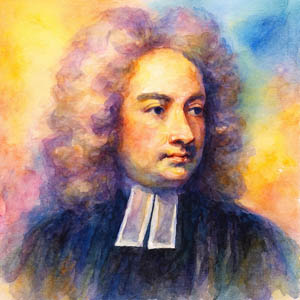
 Novelist and satirist Jonathan Swift (1667–1745) was born on this day in
Dublin, Ireland. His father, a lawyer, died before his birth, and he was raised by a
wealthy uncle. Headstrong and opinionated, Swift graduated from Trinity College and later served as an
assistant to politician William Temple.
Novelist and satirist Jonathan Swift (1667–1745) was born on this day in
Dublin, Ireland. His father, a lawyer, died before his birth, and he was raised by a
wealthy uncle. Headstrong and opinionated, Swift graduated from Trinity College and later served as an
assistant to politician William Temple.
Swift once observed, “We have just enough religion to make us hate, but not enough to make us love one another.” His work returned again and again to the gap between what people claim to believe and how they actually live.
Ordained an Anglican priest in 1695, Swift is best known for his novel Gulliver’s Travels (1726). First published under a pseudonym to avoid offence, the book follows four fantastic voyages of Lemuel Gulliver, including his visit with the tiny Lilliputians, and offers a sharp, playful satire of English society.
“Vision is the art of seeing things invisible,” he said, naming the quiet courage it takes to imagine a different world.
Swift’s remarkable essay A Modest Proposal (1729) suggested that the Irish could rid themselves of poverty and homelessness by selling their children as food to the rich. The horror of the idea made people face the real problems of hunger, injustice, and indifference in Ireland, and in humanity itself.
He also wrote, “How wild and impertinent, how busy and incoherent a thing is the imagination, even in the best and sanest of men; insomuch, that every man may be said to be mad, but every man does not show it.” For Swift, the mind was a restless landscape, full of contradictions yet still capable of truth, humor, and fierce clarity.
 Celebrate every day of your life.