
~ Alexander Pope
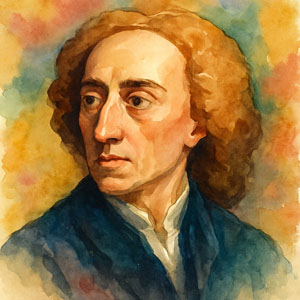 Called “the great moral poet of all times” by Lord Byron, Alexander Pope (1688–1744) was born to wealthy, elderly parents and attended Catholic schools in England.
At age twelve, a crippling spinal curvature disease forced him to learn on his own at home, and he developed a lifelong passion for books. In the quiet of that enforced solitude, his mind wandered widely, and his words began to take shape in tight, memorable lines.
By the time he was twenty-three, Pope had written the philosophical poem An Essay on Criticism, which helped define the doctrine of Classicism and included the famous line: “To err is human, to forgive, divine.”
Well-known in his time as a level-headed satirist and master of double meanings, Pope made classical ideals feel contemporary by shaping them into the tight rhythm of the heroic couplet. He formed the Scriblerus Club with fellow writers to satirize false tastes in learning and inspired the poetic parody The Dunciad (1728). “The hidden harmony is better than the obvious,” he said.
Praised by critics, Pope earned lasting success with his brilliant translation of Homer’s Iliad (1725). With a hunger for peace and nature, he retreated to a rural villa in Twickenham. On the banks of the Thames River, the property’s gardens and mirrored grotto became a haven as his physical health deteriorated.
“Fools rush in,” he wrote, “where angels fear to tread.” His lines still echo whenever we leap before we look, or when our expectations outrun reality.
For Pope, there was “a certain majesty in simplicity.” Lowering expectations of perfection, he suggested, and treasuring quiet, simple joys is one way to never be truly disappointed.
 Welcome simple joys. ✨