
— Martin Luther
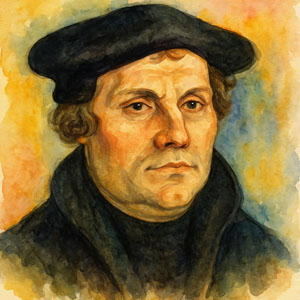 A catalyst for religious reform, Martin Luther (1483–1546) was born on this day in Saxony-Anhalt, Germany, the son of a copper miner. A scholar with an unshakable conscience, his challenge to Church abuses helped ignite the Protestant Reformation.
“If you want to change the world, pick up your pen,” he urged. A university teacher and Augustinian monk devoted to study and prayer, Luther believed faith should live in the heart, not merely in ritual.
In 1517, he wrote his Ninety-five Theses, protesting the sale of indulgences that claimed God’s forgiveness could be bought for the dead. Tradition holds that he posted the document on the door of Wittenberg’s All Saints’ Church.
“Out of love for the truth and the desire to bring it to light,” he declared, insisting that priests held no special power apart from the Gospel. He called believers back to the Bible—to a faith alive and personal.
Excommunicated in 1521, Luther stood firm: “I cannot and will not recant anything, for to go against conscience is neither right nor safe. Here I stand; I can do no other. So help me God.”
To help ordinary people better understand Scripture, he translated the Bible from Greek into German. His reforms spread across Europe, shaping communities in Britain, Germany, and Scandinavia.
Ever an instrument for change, he wrote, “The human heart is like a ship on a stormy sea, driven by winds from all four corners of heaven.” His words still stir courage to stand for what is true.
 What you love is holy.