
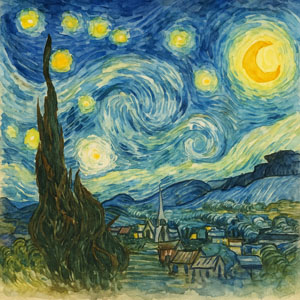
Dutch artist Vincent van Gogh (1853–1890) painted The Starry Night (1889) from memory while at the asylum in Saint-Rémy, the “veritable monastery” where he searched for calm and a truer way to see.
“The night is more alive and more richly colored than the day,” he wrote. Looking at the stars stirred his dream of what light might say. In the painting’s sky, rings and halos turn the heavens into music, an eleven-star chorus and a bright, watchful moon above a remembered village.
Created in a season of personal crisis, the work opened a new emotional path in art... a bold language of movement and feeling. With paint laid thick (impasto) and strokes that spiral with life, van Gogh made the canvas breathe.
“As we advance in life it becomes more and more difficult,” he said, “but in fighting the difficulties the inmost strength of the heart is developed.” He worked quickly when the vision came, brushwork alive with nature’s pulse. In his last years he finished seventy paintings in seventy days, part of a legacy of more than eight hundred oils.
Sometimes the gift is simply to pause and let the color speak.
 Look again.