
— Charles Sanders Peirce
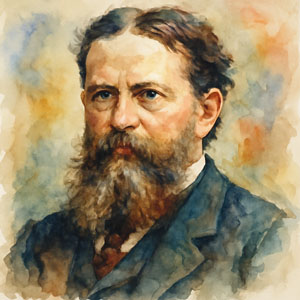 One of America’s most quietly revolutionary thinkers, philosopher and scientist Charles Sanders Peirce (1839–1914) was born in Cambridge, Massachusetts, the son of pioneering mathematician Benjamin Peirce, a founder of the Smithsonian Institution.
“The idea does not belong to the soul; it is the soul that belongs to the idea,” he once said. Even as a young man, he thought in paradox and mystery.
Inspired by Immanuel Kant and later a mentor to William James, Peirce spent his life chasing meaning. He studied gravity, experimented with pendulums, and measured the Earth—guided always by a restless love of discovery.
In the 1870s, he introduced pragmatism, the radical belief that truth is only truth when it proves itself in practice. Meaning, he argued, is not declared, but earned—through knowledge, application, and the work of living.
He expanded this vision in Fixation of Belief (1877), where he described thought as a melody, sensations as the notes. Ideas, like music, evolve with time. “Who can be sure,” he asked, “of what we shall not know in a few hundred years.”
As the father of semiotics—the study of signs and symbols—Peirce left behind over 80,000 handwritten pages. “The pragmatist,” he reflected, “knows that doubt is an art acquired with difficulty.”
He knew the road to truth was long, sometimes lonely. But still he walked it, pen in hand, leaving behind a trail of signs for us to follow.
 Follow the questions. Truth blooms when wonder lingers.🌱